The Wellness Streak Myth: A Missed Day Is Not a Verdict
The wellness streak myth turns a missed day into failure. Learn to judge a routine by its fit, usefulness and place in real life instead.
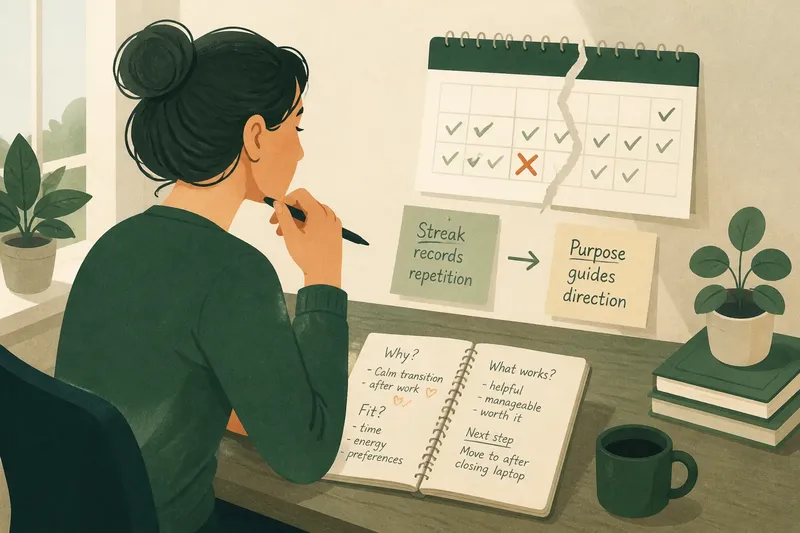
Did missing one day mean your routine has stopped working? The wellness streak myth treats an unbroken run as proof of success, but a calendar cannot tell you whether a habit suits your life. A routine is more useful when you judge its purpose and fit, not the neatness of its record.
A streak records repetition, not value
A streak is a count of consecutive days on which you have done something. It can make repetition visible, but it records only whether an action happened. It does not say why you chose it, how it felt or whether it remains worthwhile.
Routines serve different purposes. An evening walk might offer a pleasant transition out of work; journalling might give you a chance to notice what is occupying your attention. The count alone cannot tell you whether either practice is meeting its purpose.
Think of a streak as a mark on a calendar, like a tick beside a completed errand. The tick tells you the errand happened that day. It does not tell you whether it was the right errand to keep doing.
An unbroken run can distort judgement
When preserving the count becomes the goal, the routine can quietly change shape. You may do a token version to keep the streak alive, even when it no longer serves the reason you began. Or a missed day may seem to erase earlier effort, although you practised consistently before it.
This is a problem with the measure, not a verdict on your character. A consecutive-day count offers little information about whether a routine fits your changing schedule, energy, preferences or practical constraints.
A broken streak can prompt an all-or-nothing response: either return immediately to the old pattern or abandon it. Neither choice follows automatically from a missed day. Ask instead whether the routine still fits and, if so, what version is realistic now.
Judge a routine by its purpose and fit
Start by stating the reason for the routine in ordinary language. You might say, “I want a calm transition before bed” or “I would like time to read away from work messages.” A clear purpose gives you something more relevant to assess than a perfect run.
Then consider fit: can the routine sit alongside your actual responsibilities, available time and preferences? This is not a test of discipline. It helps you notice whether the habit belongs in the life you have, rather than an imagined version of your week.
Look for an observable sign that the routine serves its purpose. Perhaps you are more willing to begin, the activity feels manageable, or it gives you the pause you wanted. If you cannot identify a useful sign, you might adjust the routine rather than demand a longer streak.
Say you begin writing a few lines in a notebook after supper to mark the end of the working day. Imagine a busy evening interrupts the habit. The next evening, you notice that the notebook still helps you set work aside, but the timing is awkward. Moving it to the moment you close your laptop may make it easier to use for its original purpose.
Choose a change that answers the mismatch
Adjusting a routine is a design choice, not evidence that you have failed. Check what is happening and let the result guide your next move:
- Check whether the purpose still matters. If it does and the routine fits your usual schedule, keep it as it is; if not, change the activity or let it go.
- Check whether the activity feels burdensome. If a lighter version would still serve the purpose, make it smaller; if not, choose a different way to meet that purpose.
- Check whether the chosen time clashes with other commitments. If it does, move the routine to a more workable part of the day; if no suitable time exists, reduce how often you do it or pause it.
- Check whether doing it daily adds value. If it does, keep the daily pattern; if it adds pressure without serving the purpose, choose a less frequent pattern.
- Check whether the routine still offers anything you want. If it does, adjust its form; if its purpose has changed or disappeared, let it go.
- Check whether tracking helps you make a decision. If the record reveals a useful pattern, keep it simple; if protecting the mark distracts you from the routine’s purpose, stop counting or use brief notes instead.
These options need not become another rigid system. They help you make a considered choice instead of letting a calendar dictate what happens next.
What should you ask after missing a day?
Does one missed day mean the habit has failed?
No. It means the routine did not happen on that occasion. Whether it is still useful depends on its purpose and fit, not on a single gap in the record.
Should I restart the streak from the beginning?
You can track consecutive days if that helps, but restarting is not a requirement for continuing. You might note that you returned to the routine, or stop counting if the count distracts from its purpose.
What if I keep missing the routine?
Repeated gaps may be a reason to reconsider the timing, frequency or activity. Look for a practical mismatch rather than assuming the answer is to try harder.
Is tracking a habit always unhelpful?
No. A calendar or notebook can make a pattern easier to notice. It becomes less useful when protecting the mark matters more than deciding whether the routine suits you.
Let the record serve your decision
If you track a routine, choose a record that answers a helpful question. Instead of counting only consecutive days, you might briefly note which version you did or whether it felt worth repeating. Keep the record simple enough that it does not become a second obligation.
The wellness streak myth makes a gap look like a verdict. A more useful reading is modest: the day was missed, and you can decide what that tells you. Use the next opportunity to continue, adjust or stop based on the routine’s purpose and fit. When you search for the wellness streak myth, remember that the count is a record, not a ruling; the useful next step is the one that fits the reason you began.